


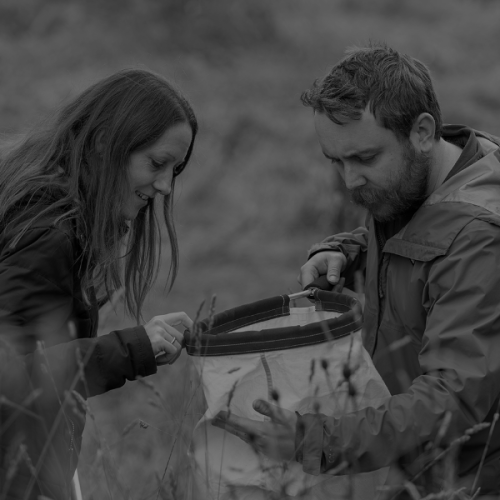


Author interview with Sophie Pavelle: To Have or To Hold
In To Have or To Hold, Sophie Pavelle dives into the dazzling world of symbiotic relationships – the good, the grotesque, and the downright bizarre. Through eight chapters, the book celebrates some of the UK’s lesser known species and the remarkable ways in which they have come to support, or exploit, their fellow organisms. Engaging and entertaining throughout, To Have or To Hold is a masterpiece in communicating complex scientific concepts in a personable, accessible manner.

Ahead of the paperback release in late July, we were delighted to talk to Sophie about the process behind the book, its key messages, and the intrigue of symbiosis itself.
Firstly, could you tell us about what drew you to the subject of symbiosis?
During my second year studying Zoology at the University of Bristol, a deceptively simple module titled ‘Parasites’ changed everything. Taught by leading experts, I became enthralled by the way parasites stitch the living world together; binding species, ecosystems and evolutionary histories in intricate, often astonishing symbioses. To Have or To Hold emerged at a moment when ‘nature connectedness’ and Britain’s fragile relationship with the living world were making headlines. As I delved into nature’s hidden alliances, I felt something rare: excitement, and genuine hope. Symbiosis, to me, reveals Earth in its truest form: complex, authentic and endlessly at work.
One significant figure in the book is the late Lynn Margulis, evolutionary biologist. Could you tell our readers a bit about her contributions to the understanding of symbiosis?
Lynn was my guiding light throughout the creation of To Have or To Hold. A remarkable American evolutionary biologist who came of age in the 1950s, she possessed a rare blend of intellectual ferocity and deep tenderness; as formidable as wildfire, yet endlessly curious about the secrets of the small. For decades, her insights into symbiosis lay obscured beneath Darwin’s towering emphasis on competition. At 28 – the same age I was while writing this book – she published her groundbreaking 1967 paper, ‘On the Origin of Mitosing Cells’, proposing that complex life could arise through the merging of species’ lives. Her legacy now underpins modern evolutionary biology, illuminating how life truly comes together.
You’ve ended up with an amazingly varied rollcall of subjects, from parasitic barnacles to lungwort lichens. How did you whittle down potential candidates to get your final list?
I set a few clear criteria to guide my choices which proved essential. Because once you start viewing the world through the lens of symbiosis, its abundance becomes overwhelming! I wanted species that would lead me across a range of British habitats, showcasing how varied and singular our archipelago is in supporting life and assemblages of species found nowhere else. Accessibility mattered too. Each location needed to be reachable by public transport, so readers might feel encouraged to follow these journeys themselves.
I also prioritised species whose relationships were supported by solid, peer?reviewed research, allowing each chapter to rest on firm scientific ground. Some organisms were so under?studied that a rigorous 12,000?word chapter simply wasn’t possible. Finally, I wanted to weave in climate research and represent a broad sweep of taxonomic groups, reflecting the full complexity of nature’s interconnectedness; from micro to macro in scale.
To Have or To Hold is refreshing for presenting and celebrating biodiversity in its entirety, not just the ‘nice’ parts. Did writing and researching the book change your outlook on parasites and other groups that get a bad rap?
I came to this book already biased toward parasites. I love the challenge of using story, science and language to shift a reader’s view of a species they might find ugly, violent or simply dreadful – to turn revulsion or apathy into curiosity and awe. As I descended into the hidden worlds of the Sacculina barnacle, the hairworm, even the early spider orchid, their sophistication astonished me. Each one responds to the universal urgency of survival with extraordinary precision. Far from diminishing them, these strategies only deepened my fascination and respect for their place in the living world.
Each chapter centres on your journeys around the country seeking out the various symbiotic relationships you describe. How important was it for you to go out and try and experience these firsthand?
Travelling to the habitats these species occupy was essential, just as it was when writing Forget Me Not. I’m a keen cyclist, and whenever the weather allowed, I rode. There’s something about pushing yourself through a landscape – heart racing, mind clearing, meeting the elements head?on – that deepens my connection to the species I’m writing about. If I can experience even a fraction of the challenges they endure, I hope I can bring them to life more vividly on the page.
And because this book weaves in the climate story, it felt important to witness the changing conditions myself. Over a year marked by named storms, marine heatwaves and drought, I travelled through the same extremes reshaping these relationships. It grounded the writing and reminded me that I’m not just observing these shifts, but living through them too.
Finally, what do you think symbiosis can teach us about our relationship with the planet and tackling the crises affecting the natural world?
That relationships are not always pretty. They require graft, ingenuity, give and take. They are complex, shapeshifting and spectacularly beneficial. Collaborations offer wildly more prosperous and exciting outcomes, and it’s in our DNA to gather and assemble – especially when there are problems to solve and decisions to make.
