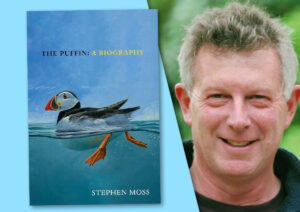


Author interview with Stephen Moss – The Puffin: A Biography
Stephen Moss is a lifelong birder, broadcaster and bestselling author, whose books have been published in over twenty different countries. The Puffin, due in October, is the seventh volume in his celebrated ‘Bird Biographies’ series, following the Robin, Wren, Swallow, Swan, Owl and Starling – as well as The Twelve Birds of Christmas, which featured the dozen species in the famous festive carol. In total these have sold well over 120,000 copies, and been translated into Dutch, German and Chinese.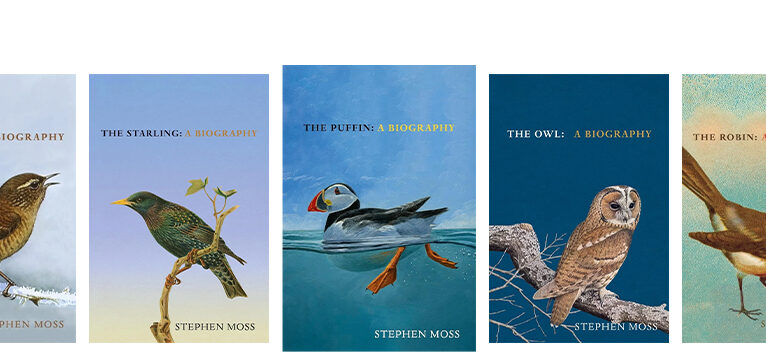
Ahead of publication of The Puffin, we had the pleasure of speaking to Stephen about the history and development of Bird Biographies and his future plans for the series.
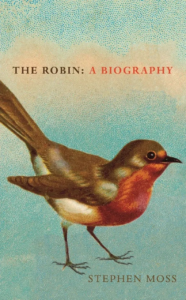
Firstly, could you give us some background on the origins of Bird Biographies – when The Robin was published back in 2017, did you know it would be the beginning of a series?
I don’t think so, no – the idea had originally come to me on my regular early-morning bike ride around the lanes near my Somerset home, as I loved David Lack’s classic Life of the Robin (published during the Second World War), and following my friend David Lindo’s poll to find Britain’s Favourite Bird, I thought that the winner (surprise, surprise – the Robin) deserved its own book. It was only when it sold over 35,000 copies in the two months from publication and leading up to Christmas that I thought it might be worth doing a second volume. I chose the Wren because it was – and still is – Britain’s commonest bird! I then only had a short time to write that book, so it could come out in time for the following Christmas. The Wren was also very popular – to date it is the second highest seller of the series with over 25,000 copies sold (The Robin has now topped 50,000).
How has the series developed in comparison to your early expectations? Has it taken any surprise turns?
My original plan was to separate the scientific and cultural aspects of the Robin, so that the literary, social and cultural material would all come after the biology and ecology. It was my wonderful agent, Broo Doherty, who suggested combining the two. That then led to the realisation – about halfway through writing that first book – that the folklore and cultural aspects of the bird – in the case of the Robin, its association with Christmas – come directly from its behaviour. For example, Robins feed on the ground and, in the days when I was growing up when we still had snowy winters, this meant that they would starve unless people fed them; so they became tame and ‘friendly’. Likewise, Robins follow gardeners as they turn over the soil because until recently, wild boars had gone extinct in Britain, so we became the substitute for them! Astonishingly, the same link between the biology and the cultural side of the bird – the behaviour leading to the folklore – also applies to all the other six species in the series. That helped create a real sense that these are ‘biographies’ of each bird.
To date the biographies have covered a wonderfully varied selection of subjects. How do you go about choosing your species?
By far the most important thing is that every species I choose must have both fascinating (and sometimes unique) behaviour and also a major human connection through history, folklore and culture. All of the seven species so far have both aspects of these; but for instance other very popular and well-loved birds, such as the Blue Tit and Blackbird, simply do not. Also each time I write a new one, I want to be surprised, and to find something different from the species that I wrote about before. Although the Robin and the Wren are both common, resident garden birds, it turns out that their behaviour and culture are very different from one another. For the third volume I really wanted to write about a migrant, and the Swallow was the obvious choice, as they are such a global traveller. Then I wanted to do a waterbird, and the Swan was also the clear frontrunner; followed by a group of birds – a choice between Owls and Crows, and the Owls won! The Starling is such a quirky bird, withy its unique murmurations and our love-hate relationship with the species; while the Puffin was the clear frontrunner as a seabird, and also because people absolutely love them.
Do you start with a particular structure for the books, or do you find that different species demand different approaches?
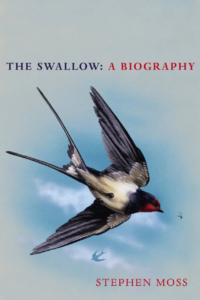
Having decided to blend the science and the culture, a month-by-month structure from January through to December was the obvious choice for the Robin, and also for the Wren. Then, when I wrote the Swallow, it made far more sense to do it seasonally, starting with their return in spring, and then covering their breeding, migration and overwintering in South Africa. I say ‘wintering’, but of course Swallows never experience winter – when they arrive there in our autumn, they enjoy a second spring and summer. I went to see the world’s biggest Swallow roost near Durban airport, with three million birds, which was truly mind-boggling! The Swan, Starling and Puffin are also seasonal, while for the Owl, I covered all seven UK species and so the format reflected this.
What’s your process for researching your subjects? Do you end up discovering new things about each bird?
I always discover new things – and even when I think I know about the bird, as with the Robin, I soon discover many more aspects of their biological and cultural lives. I start by reading about the species in my collection of old and new bird books, typing out quotes and interesting nuggets of information to use later on. I then draw up a draft list of contents and topics. For some recent volumes I have had the help of a researcher: I brief them with a series of topics and questions, and then they dig up facts and figures, stories and anecdotes, and so on. That really helps me get a new and different perspective on the bird. I then incorporate their findings into my original plan, before finally starting to write. Unlike articles, doing a book is a very iterative process: after writing, I edit each chapter before bringing them all together. My commissioning editor Molly Slight, and my copyeditor, an old friend and colleague Graham Coster, an experienced publisher and writer himself, read the text and send me their detailed feedback – after which I rewrite some sections and hone the book into its final draft. Then the publishers typeset it, and add the illustrations, so that I see the text as it will appear to the reader. We make any final corrections, and the book goes off to be printed!
Finally, the obvious question: can you tell us anything about what’s next for the series? Do you already have other subjects in mind?
As I am officially semi-retired, I now write one volume every two years, rather than one, so we’ll decide the next species sometime early next year for publication in autumn 2028. Given the need for the bird to have that crucial combination of special behaviour and cultural stories, there are a number of frontrunners: Skylark, Kingfisher and House Sparrow are the top three. Of those, I really want to write about the House Sparrow – a bird I grew up with, and which has a fascinating story to tell!