


Book review – In Search of Sea Dragons: A Fossil Hunter’s Odyssey
 ***** An engrossing tale of fossils and obsession
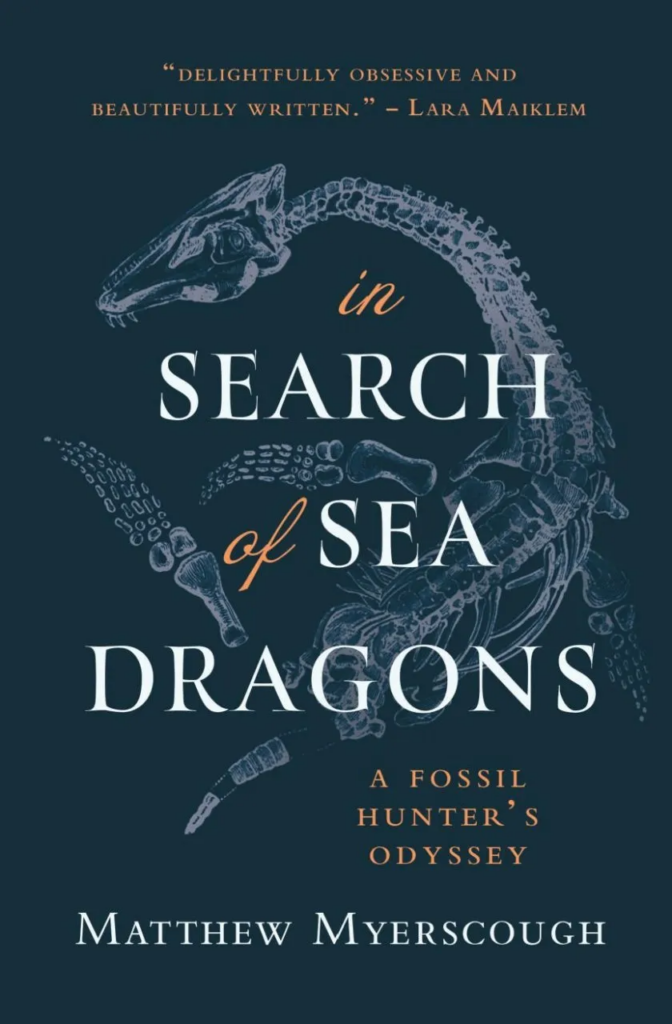
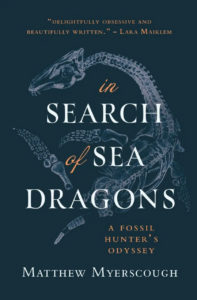
In In Search of Sea Dragons, civil engineer and fossil hunter Matthew Myerscough vividly tells his personal tale of hunting for fossils on the more remote beaches of Wales and South West England, as hobby transforms into obsession.
The author’s pivot from mountaineering to fossil collecting was rather traumatic. After surviving being buried alive by an avalanche on Yr Wyddfa (Snowdon) in Wales, he is psychologically scarred and can no longer find solace in the mountains: “I felt like I had lost my sanctuary” (p. 34). Instead, he turns to the seashore to go fossil hunting. The memoir that follows documents a years-long personal journey from novice to experienced collector. Though he remains vague on the dates, a few touchstones (the avalanche’s tenth anniversary in 2024, storm Eunice, which happened in 2022) place this story in the decade after 2014. As he scours beaches in South Wales, Somerset, and North Yorkshire, and his skills and obsession grow, the stakes keep being raised. Soon, nothing less than his very own complete ichthyosaur skeleton will do.
I found Myerscough’s descriptions of the landscapes and rock formations particularly vivid, perhaps because I live in South Devon, only an hour’s drive away from some of these beaches, and am familiar with the local scenery. Whatever it may be, his writing transported me there, standing under wide open skies on the beach, sharing in his excitement, and vicariously enjoying some adventuring of my own. This literal situation of the reader is aided by three colour plate sections with photos of some of his remarkable discoveries, while maps show the different beaches where he made key finds (though the greyscale reproduction is poor in places).
With time, he finds some exceptional and rare fossils, including parts of a rhomaleosaur (an early pliosaurid), an articulated plesiosaur flipper (which are rarer still than those of ichthyosaurs), and substantial parts of an ichthyosaur skeleton. Though snippets about the biology of these extinct marine reptiles crop up here and there, they are not the focus of this book. Neither is this a practical guide to fossil hunting, though some tips, codes of conduct, and hard-won experience are sprinkled throughout.
In Search of Sea Dragons is foremost a memoir, and it is as much an internal as an external odyssey. Not that I wish to psycho-analyse the author, but he wears his heart on his sleeve and prominently writes about his feelings and emotions. Perhaps unintentionally, the book provides a revealing glimpse of the darker side of becoming obsessed with one’s hobby. Below, I will elaborate on the aspects that led me to this conclusion, to which I add that this is not intended as a personal judgement of Myerscough’s character.
The author is remarkably candid about the feelings he is working through and the new ones he encounters. While he continues to be plagued by guilt and insecurity over the avalanche, the beach becomes a new sanctuary: a place to unwind, release stress, slow down, and commune with nature. And yet, you do not even have to read between the lines to notice it brings with it a whole new suite of anxieties. Though there is the excitement of finding new fossils and forging new friendships, there is also self-doubt (“Was this really how I wanted to spend my precious time”, p. 55) and jealousy at others’ fossil discoveries (“This had happened on my turf and I felt sick with envy thinking about this missed opportunity”, p. 53). As his skills increase and his spectacular finds win him the admiration of other fossil hunters, there is an undercurrent of dissatisfaction that surfaces most clearly towards the end. Despite finally finding large parts of an articulated ichthyosaur skeleton, possibly preserving stomach contents and skin fragments (!), he writes that “None of it was quite what I had hoped for” (p. 174).
His hobby turning into an obsession is something he admits to himself. A large boulder stuffed with plesiosaur bones “began my obsession with the huge bone blocks, the sort that most people would assume impossible to move” (p. 136). In one passage that is as comical as it is absurd, he almost turns into Gollum as he entertains the idea of shouting and hurling objects at two approaching fossil hunters to distract them from his “treasure” (p. 131): a promising boulder he has just discovered. As the fossils pile up faster than his friend Mike can prepare them, first the sheds and then the house start filling up with rocks. You have to wonder, as a visiting plumber seems to do, what his partner makes of this. She is notably absent after the first few chapters and, clearly, this is a hobby they do not share.
What really raised my eyebrows is his continued risk-taking behaviour. Despite his earlier brush with death, he purposefully ventures out on wet and wintry days, seeking out remote beaches where other people are as absent as is mobile phone coverage. When rooting around in a distant cove in the predawn darkness one morning, trying to relocate a particular rock, he worries about having an accident: “was my obsession with these bones leading me to take unnecessary risks?” (p. 134). And there are accidents, with slips and falls resulting in bruised legs and broken ribs. “Perhaps I am foolish or just stubborn, but I love what I do and I won’t stop, despite these risks” (p. 117). The most extreme example of this is the chapter where, together with another experienced local fossil hunter, he abseils from the cliffs at Whitby (famous for both Bram Stoker’s Dracula *and* fossils). Using rotten ropes and rickety steps left behind by fishermen, they descend hundreds of feet onto angular, car-sized boulders. Any slip here would be lethal. Though he finds something truly spectacular, the chapter opens with a sternly worded warning about the extremely dangerous setting, even for experienced fossil hunters. He advises against going here, has kept the location anonymous, and especially warns against using ropes to descend cliff faces… to then promptly do so himself.
I will be honest that I felt a certain sense of relief for him when reaching the epilogue, where we now find the author living in Cumbria, spending far less time collecting fossils. The way this tale was headed, death, injury, or the disintegration of his relationship under the literal weight of fossils only seemed a matter of time. The honest and open exposition of his inner odyssey, together with his vivid descriptions of landscapes, make for an engrossing memoir. I devoured the book in a few sittings and expect that it will strongly appeal to fellow fossil hunters and, more broadly, to readers interested in palaeontological exploration.